Nearly Half of Centre County Households Are Struggling to Afford the Basics. Here’s How We Can Help.

In a county known for prosperity and opportunity, nearly half of all households struggle to afford the basic cost of living.
According to the latest ALICE Report for Centre County, a statewide data project launched by United Way of Pennsylvania, 27% of local households are classified as ALICE (Asset Limited, Income Constrained, Employed) and an additional 19% live below the federal poverty line. Together, that means 46% of Centre County households are living below the ALICE Threshold, earning too little to consistently afford basic necessities such as housing, food, transportation, childcare, and healthcare.
In Centre County, where there are 62,175 households, 27% are ALICE households and 19% are living in poverty. This equates to 46% of Centre County households struggling to afford basic needs.
That statistic may come as a surprise in a county often viewed as one of Pennsylvania’s success stories. Home to Penn State University, highly ranked schools, and communities that regularly appear on lists of desirable places to live, Centre County is often associated with economic stability and a high quality of life.
Yet beneath that perception lies a more complicated reality.
Many families are working, paying their bills, and doing everything they can to stay afloat. They are teachers, healthcare workers, retail employees, childcare providers, service workers, and retirees living on fixed incomes. For most, the challenge is not a lack of work or effort. It is the growing gap between what life costs and what many households earn.
The result is a growing number of residents who may not fit traditional definitions of poverty but who nevertheless find themselves making difficult choices between competing necessities. A family may delay medical care to keep up with rent. A senior may cut back on groceries to afford prescription medications. A parent may work multiple jobs while struggling to cover childcare costs. These situations often remain hidden, but they place significant strain on households throughout the county.
Housing has become one of the clearest examples of this growing pressure. Centre County’s FY 2025–2026 Human Services Block Grant Plan identifies housing instability, homelessness prevention, and supportive housing among the county’s highest human service priorities. Local organizations continue to provide emergency shelter, rapid rehousing, and homelessness prevention services as demand persists across the county.
The issue extends beyond homelessness itself. Housing providers increasingly encounter working individuals and families who cannot find affordable housing, seniors living on fixed incomes who struggle to keep pace with rising costs, and households that remain one financial setback away from losing stability. As housing costs consume a larger share of household budgets, families have fewer resources available for food, healthcare, transportation, and other necessities.
Food insecurity presents another challenge that often goes unseen. While Centre County is frequently associated with affluence, thousands of residents continue to struggle with reliable access to food. According to Feeding America’s Map the Meal Gap study, an estimated 8,840 Centre County residents, including more than 2,100 children, experience food insecurity. Behind those numbers are working families, seniors on fixed incomes, and individuals facing unexpected financial setbacks who are increasingly forced to make difficult tradeoffs when budgets become stretched beyond their limits.
Mental health needs are also placing increasing demands on the county’s human services network. Centre County’s human services planning process and the Mount Nittany Health Community Health Needs Assessment identify behavioral health as a significant concern affecting local residents. Healthcare providers, educators, nonprofit leaders, and community stakeholders continue to report growing demand for mental health services across age groups and income levels.
What makes these challenges particularly difficult is that they rarely occur in isolation. Financial hardship can contribute to housing instability. Housing instability can worsen mental health challenges. Limited access to childcare or transportation can make it harder to maintain employment. Increasingly, human service organizations are encountering individuals and families facing multiple interconnected challenges at the same time.
For decades, Centre County’s nonprofit community has served as a critical safety net for residents facing these circumstances. Organizations throughout the county provide emergency shelter, food assistance, counseling, crisis intervention, family support services, healthcare access, and programs that help individuals regain stability and independence. They are often the first place people turn when life becomes overwhelming and the last resource available when other options have been exhausted.
Yet many of these organizations are navigating growing pressures of their own. Demand for services continues to rise while operating costs, staffing expenses, and program costs increase. Many human service organizations depend on a complex mix of federal, state, county, foundation, and private funding. Public funding streams are often restricted to specific programs, awarded on annual cycles, and subject to changing government priorities. As nonprofits face increasing demand, flexible philanthropic funding becomes increasingly important because it allows organizations to respond quickly to emerging needs and fill gaps that traditional funding sources cannot always address. The importance of these locally controlled resources is reflected throughout Pennsylvania’s County Human Services Planning Framework, which recognizes the need for communities to address changing local conditions and priorities.
This is where the Fund for Centre County plays an important role.
Unlike funding restricted to a single organization or program, the Fund for Centre County allows Centre Foundation to respond to the community’s most pressing needs as they emerge. It provides flexible resources that can support local nonprofits, strengthen essential services, and help organizations adapt as community challenges evolve.
This year, that work comes with a unique opportunity. In celebration of Centre Foundation’s 45th anniversary, the Edward and Charlene Friedman Charitable Foundation has established a dollar-for-dollar matching challenge through the Fund for Centre County.
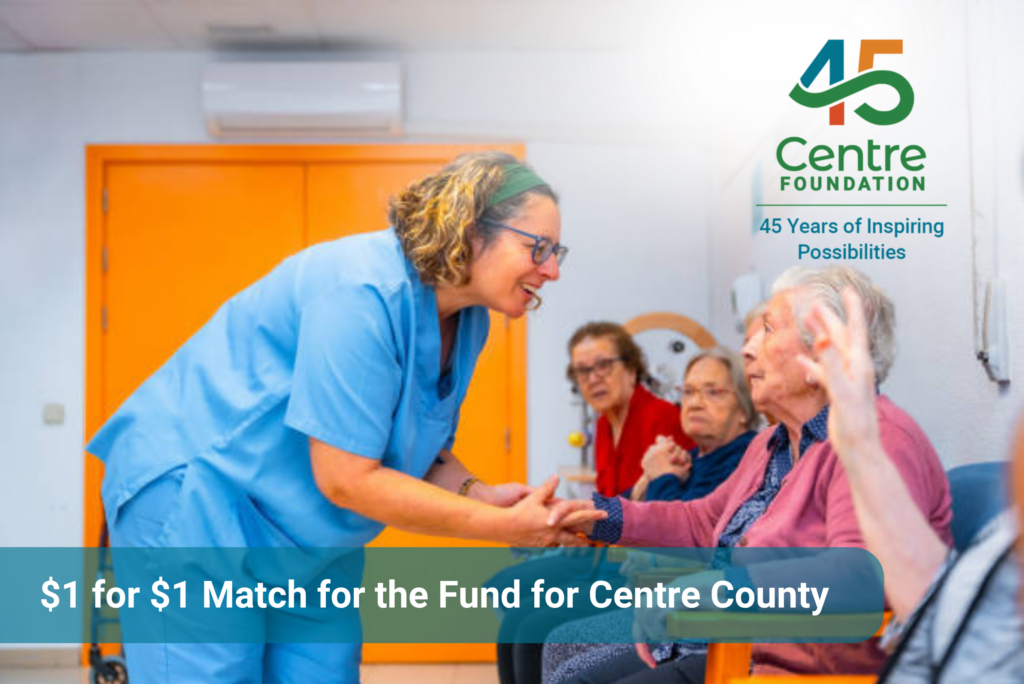
In 2026, every eligible gift to the Fund for Centre County will be matched dollar for dollar!
The goal is to raise $225,000 from the community and unlock an additional $225,000 in matching funds, creating up to $450,000 or more to support human service programs throughout Centre County.
At a time when nearly half of local households are living below the ALICE Threshold, when housing instability remains a growing concern, when thousands of residents face food insecurity, and when demand for mental health services continues to rise, every dollar invested has the potential to strengthen the organizations working on the front lines of these challenges.
The needs facing Centre County today may not always be visible. They often exist behind closed doors, hidden from public view. But they are real, and they affect our neighbors, coworkers, friends, and family members.
The good news is that this is a challenge we can meet together.
A gift to the Fund for Centre County today will go twice as far, helping local nonprofits provide food, shelter, counseling, crisis support, healthcare access, and other essential services that strengthen our community every day.
For 45 years, Centre Foundation donors have helped meet the needs of the moment. Today, that moment is here again.
Make your gift. Double your impact. Help strengthen the safety net that thousands of Centre County residents rely on every day. Visit CentreFoundation.org/fundforcentrecounty to learn more and donate today!